

Skip to content

Architecture and governance

One shared platform. Autonomous organisations. Governance under control.

Bring teams, banners, brands and partners together in a collaborative cloud environment: an organisation that reflects each party’s responsibilities, traceable processes and open integration with your information system.

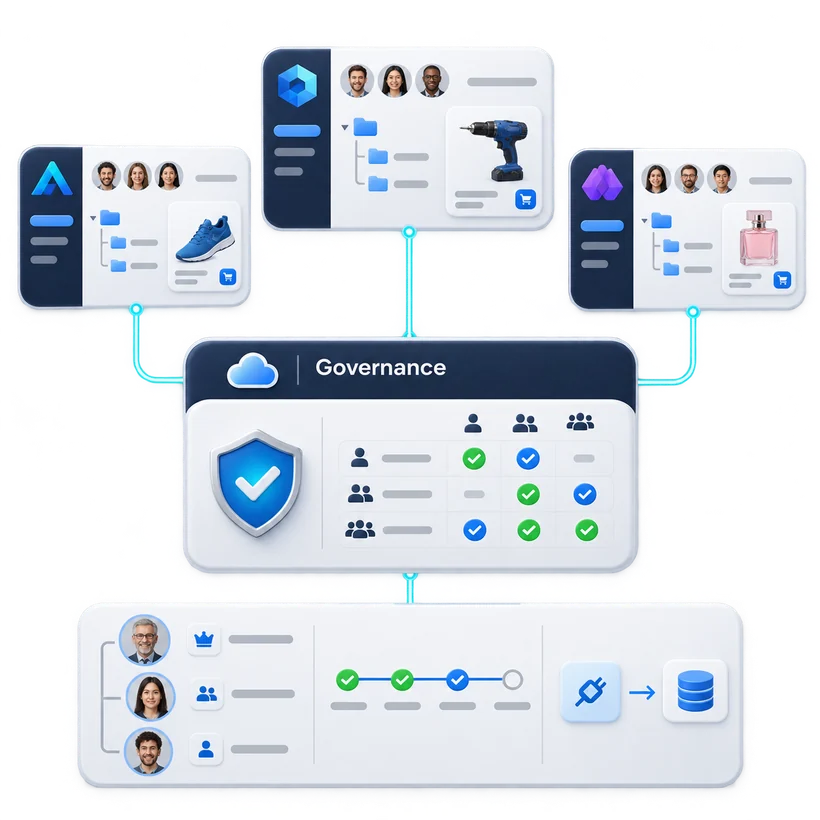
Three banners connected to shared governance: roles and rights by profile, approval workflow and integration with the information system

Share technology and content without imposing a single organisation

Companies manage their product information, media and commercial communications within increasingly complex organisations. Several banners share a single repository while keeping their own assortments, campaigns and publications. Users belong to different departments, brands, subsidiaries, stores or partners.

Pimalion was designed for this reality. Its cloud platform brings the two value chains, Product Data and Multichannel Publishing, together in a shared environment. The architecture structures organisations, governs access, tracks changes and integrates with existing applications.

Modules and services are activated according to each company’s needs and processes. Every contributor has the information and access suited to their responsibilities.

Four pillars

The shared foundations of the platform

Organise

Banners, brands, entities, languages and destinations in a shared environment, each within its own scope.

  • Multi-label
  • Multilingual

Govern

Roles, permissions, workflows, quality rules and change history.

  • Roles
  • Workflows
  • Traceability

Secure

Controlled access, European hosting and technical documentation to evaluate the platform.

  • Access
  • Hosting
  • GDPR

Evolve

Modular architecture, API and integration services: start with one need, extend later.

  • Modules
  • API
  • Standards

Governance and architecture

Ten capabilities for complex organisations

From multi-entity organisation to integration with the information system, what enables several teams and partners to work on one platform.

One shared platform, with spaces tailored to each organisation

Pimalion organises several banners, brands, departments, entities or clients in a shared environment. Products, media, templates, campaigns and publications are structured according to the scopes defined for each organisation.

Teams have the content they need for their activities and work within the responsibilities assigned to them. Resources and processes are shared where useful, while distinctions between entities are maintained. The approach suits multi-banner groups, buying groups, multi-brand manufacturers, international organisations and agencies.

Capabilities

  • Multi-label organisation
  • Several brands or banners
  • Structuring by entity or department
  • Differentiated workspaces and scopes
  • Shared content and specific content
  • Templates and publications per label
  • Access according to users and responsibilities
  • Multi-client environments for agencies

Main benefit

Share the platform while preserving the scopes and responsibilities of each organisation.

Business example

A retail group operates three banners. Products, media and production methods are partly shared. Each banner keeps its own campaigns, design rules and publications, in a shared environment, without all of them having to work the same way.

Logical separation of content and rights per organisation or label are application-level mechanisms. The terms of storage and hosting environment isolation are specified in the technical documentation, depending on the architecture deployed.

Two value chains

One platform, from product data to publication

Product Data collects, structures, enriches and manages product information and its media. Multichannel Publishing organises campaigns, prepares publications, automates their design production and coordinates approvals. Together, they connect product content to its commercial use, with no re-keying.

  1. 01

    Collect

    ERP, suppliers and files via ETL and DIS

  2. 02

    Structure

    Models, classifications and quality with the PDM

  3. 03

    Centralise

    Products and media in the PIM and DAM

  4. 04

    Enrich

    Descriptions, attributes and translations with Purify

  5. 05

    Orchestrate

    Campaigns, operations and offers

  6. 06

    Plan

    Publications, editions and channels

  7. 07

    Produce

    DPS layout and ART rendering

  8. 08

    Approve

    Proofreading and approval in PAT

  9. 09

    Distribute

    API, DEX and connectors to channels

A shared foundation

Users, roles, entities, languages and history are shared by all modules: a single organisation to administer, whatever the extent of the activated scope.

  • Multi-label
  • Roles
  • History
  • Multilingual

An open architecture

Each chain opens onto the information system: a third-party PIM can feed Publishing, Purify can enrich an existing repository, and publications reach their channels via API.

  • REST API
  • ETL
  • DIS
  • DEX

Two value chains. One platform. Shared governance.

Technical reassurance

Concrete information to evaluate the platform

An IT department cannot evaluate a SaaS platform on the strength of a "hosted in Europe" label alone. Security, hosting and operational commitments are described in the technical and contractual documentation, provided as part of a project evaluation.

Access and data security

Pimalion supports its clients in defining access scopes and organising user rights. The hosting architecture and security measures are covered by technical documentation.

Specified in the documentation

  • Authentication and passwords
  • Encryption of exchanges
  • Administrator access
  • API integration security
  • Incident management

European hosting and GDPR

Data is hosted in Europe, on Microsoft Azure, West Europe region. The processing of personal data and the responsibilities of each party are governed by the applicable contractual provisions.

Specified in the documentation

  • Providers and sub-processors
  • Backups and copies
  • Data processing agreements
  • Retention periods
  • GDPR-related requests

Availability and continuity

Commercial production processes are time-sensitive. Availability, backup, restoration and support commitments are defined in the technical and contractual documentation for the services subscribed.

Specified in the documentation

  • Availability commitment
  • Maintenance windows
  • Backup and restoration
  • Incident management
  • Support arrangements

AI governance

Purify and AI Reviewer assist with the preparation, enrichment and checking of content. Teams review and approve generated or corrected content before it is used: AI assists, it does not replace approval.

Specified in the documentation

  • Data sent to AI services
  • Providers and processing regions
  • Data retention
  • Use for model training
  • Human approval

Portability and reversibility

APIs and import-export services move product data, media and content to other systems. Return and end-of-contract arrangements are defined in the applicable commitments.

Specified in the documentation

  • Export formats
  • Product repository and assets
  • Metadata and relationships
  • Return conditions and timeframes
  • Handling of data at end of contract

Request the technical documentation

Technical questions

Only operational, documented mechanisms are presented. No security certification or availability rate is claimed on this site.

Depending on your role

What the architecture brings to each profile

One platform, different expectations: technical evaluation, repository governance, campaign coordination, entity autonomy.

IT departments

A modular cloud platform that integrates with existing systems, with technical documentation on security, access and operations.

Value
A clear framework for technical evaluation and integration.

Data and PIM managers

A consistent organisation of data, rights and quality rules.

Value
Structure the governance of product repositories.

Marketing departments

Organised collaboration between teams, banners and partners.

Value
Better coordinate campaigns and publications.

Multi-banner groups

Shared tools and content, with differentiated scopes of use.

Value
Combine group consistency with banner autonomy.

Agencies and studios

A multi-client environment where roles, content, publications and workflows are organised per advertiser.

Value
Industrialise without mixing responsibilities or client environments.

Buying groups and networks

A central organisation connected to its members and points of sale, with tailored content and services.

Value
Share data and commercial production.

FAQ

Architecture and governance: your questions

Answers to the questions most often asked by IT departments, Data managers and marketing teams.

Book a demo
Can several banners be managed on the same platform?

Yes. The multi-label architecture allows several banners, brands, departments or entities to work in a shared environment. Each organisation has its own scope of data, templates and publications, with appropriate access rights. Resources and processes are shared while preserving the specific features of each entity.

Is one banner’s information kept separate from the others?

The platform organises content and rights by entity. The exact terms of application-level and technical isolation are described in the technical documentation, depending on the architecture deployed.

How does Pimalion organise access and responsibilities?

Through roles and permissions adapted to each user’s responsibilities. Marketing, purchasing, Data, design studios and external partners take part in the processes that concern them, with the appropriate authorisations.

Can we work with agencies and external partners?

Yes. External contributors collaborate in the intended processes, according to the access granted to them.

Does Pimalion keep a history of changes?

Yes. Changes to product information can be tracked down to field level, and versioning makes it possible to compare how content and publications have evolved. Pimalion also traces where products are used across communication materials.

Can several languages be managed?

Yes. Content is organised by language and destination, with publications adapted to the relevant markets and editions.

Can Pimalion integrate with the software we already use?

Yes. The REST API, the ETL module and the DIS and DEX automated import-export services build exchanges with ERP, CRM, e-commerce platforms, business applications and publishing tools. Pimalion complements the information system without requiring existing applications to be replaced.

Do we need to adopt all the modules?

No. The modular architecture lets you define a scope suited to the project, subject to dependencies between services, and then extend it. In particular, you can keep an existing PIM and use Purify or Pimalion’s Publishing tools.

Can Pimalion handle large volumes?

Yes. Pimalion is used in retail and commercial publishing environments that manage large volumes of products, media and materials, for example at CARREFOUR BELGIUM, HUBO and SOCODA. Performance depends on the configuration chosen.

Where is data hosted and how is its protection governed?

Data is hosted in Europe, on Microsoft Azure, West Europe region. Access, role and permission management controls what users can do. Security, hosting and personal data protection commitments are specified in the technical and contractual documentation, provided when a project is being assessed.

What guarantees exist for backups and availability?

The technical measures and service commitments are described in the operational documentation and the applicable contracts.

Can we export our data?

Pimalion provides export and integration mechanisms. The resources, formats and return conditions are specified according to the scope of the contract.

What sets the Pimalion architecture apart from a traditional PIM or DAM?

Pimalion brings two value chains together in a single platform. Product Data collects, structures, enriches and manages product information and its media. Multichannel Publishing organises campaigns, prepares publications, automates their design production and coordinates approvals. Product content is linked directly to its commercial use, with no re-keying and no scattering across several tools.

Take the next step

See Pimalion with your own data.

A tailored demo: your catalogue, your flyers, your channels. 45 to 60 minutes.

  • With your data

    Your catalogue, your media

  • 45 to 60 minutes

    Prepared for your business

  • A clear quote

    Only the offers you need