

Skip to content

PIM · Product Information Management

Much more than a product repository

Centralise, structure, enrich and share your product data in a collaborative, multilingual and multi-brand environment, built to feed digital commerce as well as your campaigns and commercial publications.

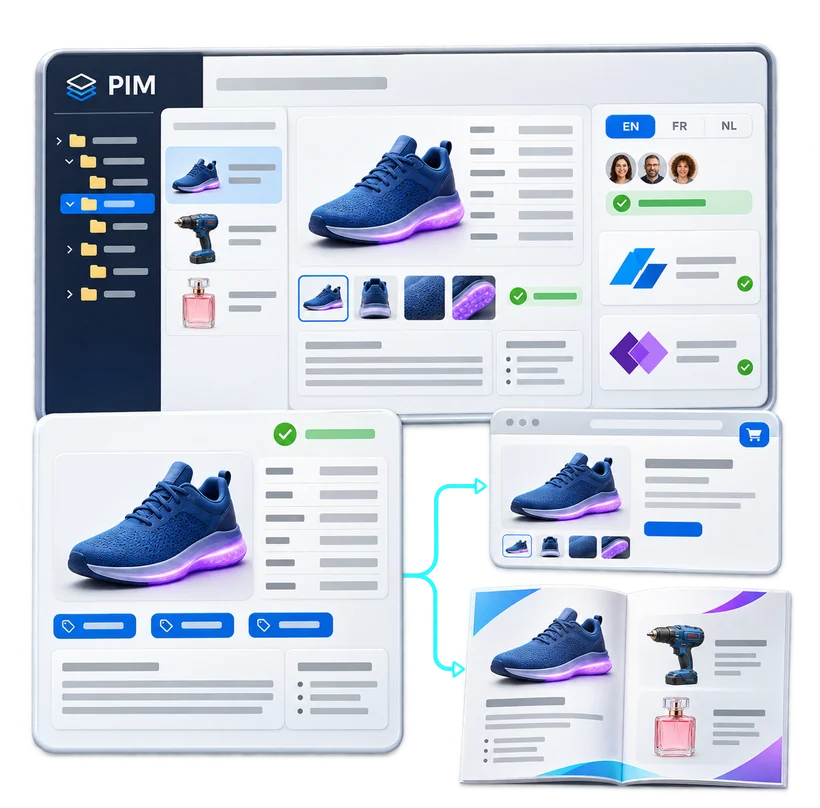
PIM repository with taxonomy, multilingual product record and approval, whose data feeds an online store and a printed catalogue

The starting point for all your commercial communications

Pimalion’s PIM lets distributors, manufacturers, buying groups and retail banners centralise and control all their product information. Configurable data models, taxonomies, attributes, variants, languages and destinations: it forms a structured repository that grows with you.

Teams collaborate on shared information, track its completeness and control how it changes. With the DAM, the PDM and Purify AI, content becomes reliable, enriched and suited to every use.

What sets it apart: its integration with Multichannel Publishing. The same data feeds e-commerce sites, catalogues, folders, POS material and digital publications, with no re-keying.

Benefits

  • Configurable data models per product family
  • Multi-user collaboration, field-level history
  • Tracked completeness and quality rules
  • Management by language, brand, destination and entity
  • Content enrichment with Purify AI
  • Traceability of products in publications

The PIM in detail

Six capabilities for a professional repository

From the structure of your assortments to AI enrichment, what turns a product repository into a working tool for all your teams.

Data models that fit your assortments

Every product family has its own characteristics, rules and information requirements. Pimalion’s PIM builds configurable data models for each category: taxonomies, families, sub-families, attributes and value lists.

Text, numbers, dates, lists, calculated values: field types cover all structured information, as well as hierarchies, variants and relationships between products. Food, DIY, car accessories or industrial supplies, every complex catalogue finds its structure.

Capabilities

  • Configurable models per product family
  • Taxonomies and nomenclatures
  • Typed attributes and value lists
  • Calculated fields
  • Classification and hierarchies
  • Variants and product relationships
  • References and identifiers
  • Models specific to categories and trades

Main benefit

A product structure that fits the business, rather than a business forced to fit a rigid structure.

The Pimalion difference

From product repository to publication, seamlessly

Pimalion was born from the demands of retail and commercial communication. Its PIM is connected to the Multichannel Publishing tools: the same data feeds planning, graphic production and approval, for catalogues, folders, posters, POS material and digital publications.

  1. 01

    Collect

    ERPs, suppliers and other systems

  2. 02

    Structure

    Information in the PIM

  3. 03

    Enrich

    With the PDM and Purify

  4. 04

    Select

    Products and offers for campaigns

  5. 05

    Plan

    Publications in the Planner

  6. 06

    Produce

    Media with DPS and ART

  7. 07

    Approve

    Publications in the PAT

  8. 08

    Distribute

    To every destination channel

Know where your products are used

Every product is linked to its uses: you can find the media it appeared in, and previews show how it looks in each template.

  • Usage history in publications
  • Media concerned identified
  • Graphic and PDF previews
  • Data used in templates

A PIM open to your information system

With the ETL, the API and connectors, the PIM exchanges data with your ERPs, business applications and e-commerce platforms, without forcing you to replace the tools in place.

  • API and automated exchanges
  • ERP integrations
  • Excel and CSV import and export
  • Synchronised inbound and outbound feeds

A PIM that does not stop at managing product information: it takes a direct part in turning it into commercial communications.

FAQ

Frequently asked questions about the PIM

Another question? Ask it during a personalised demo.

Book a demo
What is the difference between a PIM and an ERP?

The ERP manages the company’s operations and transactions: purchasing, stock, orders, accounting. The PIM structures and enriches the product information needed to sell. The two are complementary and exchange information.

What is the difference between a PIM and a DAM?

The PIM structures product information: attributes, characteristics, descriptions. The DAM centralises and organises media: images, videos, documents and other assets. Pimalion links the two.

Can Pimalion connect to an existing ERP?

Yes. The integration modules and the API build exchanges with your existing systems, within the possibilities and constraints of each environment.

Does the PIM handle several brands and languages?

Yes. Content is organised by language, destination and entity, including in multi-brand and multi-banner environments.

Can data be enriched with artificial intelligence?

Yes. Purify services optimise and enrich product content, in particular descriptions, attributes, classification and translations.

Can the PIM feed e-commerce sites?

Yes. Structured data is prepared and sent to e-commerce platforms through the appropriate connectors and integration interfaces.

Can Pimalion also produce catalogues and folders?

Yes. Unlike a repository limited to data management, Pimalion’s PIM works directly with the Multichannel Publishing modules to produce your commercial media.

Can Purify work with another PIM?

Yes. Purify can be used as a standalone service connected to a third-party system, without deploying Pimalion’s PIM.

Take the next step

See Pimalion with your own data.

A tailored demo: your catalogue, your flyers, your channels. 45 to 60 minutes.

  • With your data

    Your catalogue, your media

  • 45 to 60 minutes

    Prepared for your business

  • A clear quote

    Only the offers you need