

Skip to content

ART · Automated Rendering Technology

One creation, thousands of variations

Automate the generation of your print and digital publications from Pimalion’s product data, media and graphic compositions. Produce the versions suited to each channel, format, language, banner or store, without multiplying manual operations.

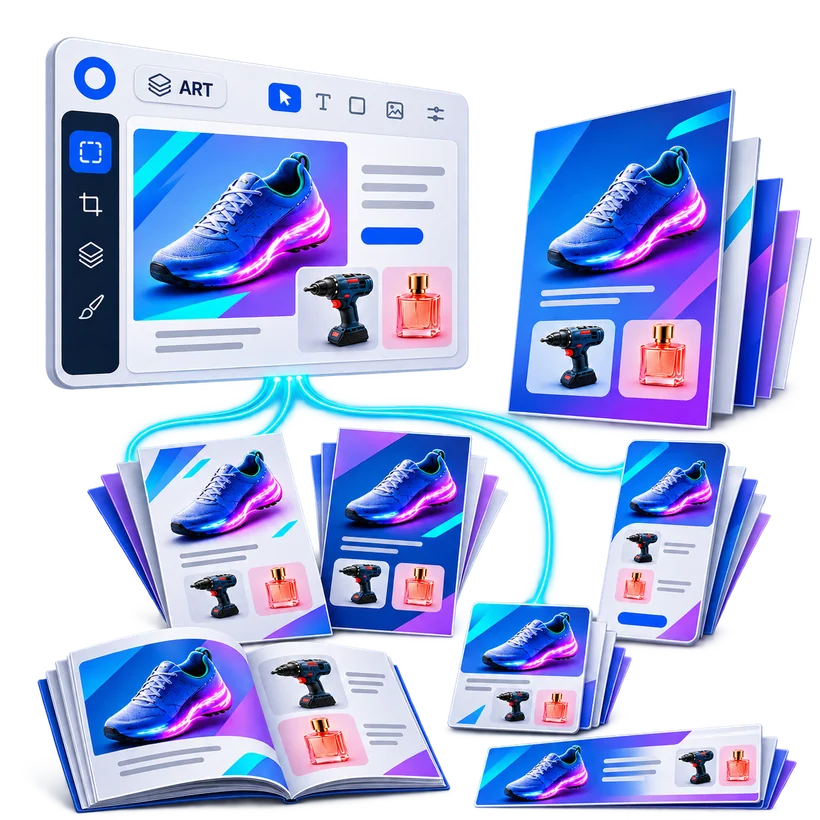
One creation automatically adapted into posters, folders, catalogues, banners and digital formats

One operation, used across all your media

A commercial communication now lives on a multitude of media. A national folder becomes several language editions, store posters, shelf labels, web banners, social media visuals and screen content. Each medium has its own constraints, and producing them by hand is a heavy burden for networks that renew their campaigns frequently.

ART, Automated Rendering Technology, is Pimalion’s automated graphic generation engine. Working with the DPS and the content repositories, it produces the renderings each medium needs, according to the templates and parameters defined. The same products, offers and digital assets are used in many versions, each adapted to its destination.

ART turns the production of commercial media into an industrialised, repeatable process, for print and digital alike.

Benefits

  • Automatic PDF, PNG, JPEG and HTML renderings
  • Print and digital from a single production engine
  • Multichannel variations from shared content
  • Versions by store, banner, market and language
  • Regeneration after correction, according to configured processes
  • At CARREFOUR: 40,000 documents in around twenty minutes, every week

ART in detail

Nine capabilities to industrialise your renderings

From file generation to variations by channel, store or language, what makes ART a production engine rather than a simple conversion tool.

Automate the production of your graphic files

Exporting, converting, preparing: when thousands of media are at stake, these tasks become a productivity issue. ART automatically generates the graphic renderings of the publications defined in Pimalion.

Production templates set the formats, technical characteristics and parameters of each output. Repetitive export operations disappear, media are available sooner and results become repeatable.

Capabilities

  • Automatic rendering generation
  • PDF documents
  • PNG and JPEG files
  • HTML renderings, depending on the processes in place
  • Production from compositions and templates
  • Several versions per publication
  • Shared content reused
  • Integrated with Publishing processes

Main benefit

Less manual work to prepare publication files.

The Pimalion difference

DPS composes. ART generates and adapts.

The DPS builds publications from product data, visuals and composition rules. ART produces the renderings adapted to destination formats and media, at scale: at CARREFOUR Belgium, 40,000 documents in around twenty minutes, every week. With PAT, these renderings go straight into review and approval.

  1. 01

    Compose

    The DPS prepares the publication

  2. 02

    Generate

    ART produces the rendering

  3. 03

    Review

    Contributors examine it in PAT

  4. 04

    Correct

    Changes are taken into account

  5. 05

    Regenerate

    ART produces the updated version

  6. 06

    Approve

    Managers sign off

Controlled design, automated production

The DPS prepares the layout of a promotional folder. ART generates the print versions and, according to the planned rules, the posters, digital formats and point-of-sale content.

  • Composition by the DPS
  • Renderings and variations by ART
  • A consistent creation

Renderings ready for approval

ART produces the preview files in the planned formats. In PAT, teams view, annotate and manage corrections before approval: production and control move closer together.

  • Renderings for review
  • Annotations in PAT
  • Updated version regenerated

Generating is not distributing

Files feed printing, digital availability or distribution to channels. Posting a visual on a social network requires a suitable connector, interface or distribution process, which APIs help to link.

  • PIM, DAM and DPS content
  • Print, web and signage files
  • Distribution via API or connectors

Controlled graphic design. Automated production at scale.

Business uses

Automated renderings in every sector

From the weekly store poster to the multilingual catalogue, the same engine adapts communications for very different sectors.

Food retail

Posters, labels and promotional media adapted every week for the whole network. Example: CARREFOUR.

Value
Very large volumes of media, at the pace of campaigns.

DIY and garden

Folders, catalogues and POS material in several languages and for several banners. Examples: HUBO / COLOS, MR. BRICOLAGE.

Value
Organised multilingual, multi-banner production.

Mass retail

From the commercial plan to the leaflet, publications adapted for complementary banners. Example: MONOPRIX / GÉANT.

Value
Generation built into a complete promotional chain.

Franchises and buying groups

Local media generated from shared templates, adapted to each point of sale.

Value
National consistency and local needs reconciled.

Digital signage

Content for in-store screens and digital formats, produced from the same data as print.

Value
Screens fed without separate production.

Agencies and studios

Automated variations in a multi-client environment, with the studio keeping control of creation. Example: TOUCH Agency.

Value
Creative expertise freed from repetitive tasks.

FAQ

Frequently asked questions about ART

Another question? Ask it during a personalised demo.

Book a demo
What is ART in Pimalion?

Automated Rendering Technology is Pimalion’s automated graphic generation service. It produces renderings adapted to print and digital media.

What is the difference between ART and DPS?

The DPS builds and composes publications. ART generates the renderings and variations from the prepared content and compositions.

Can ART generate PDFs?

Yes. PDF is one of ART’s output formats.

What other formats can be produced?

Notably HTML, PNG and JPEG. Available formats depend on the processes and configurations used.

Can several media be generated from the same content?

Yes. The same data and content are turned into media suited to each channel: folder, poster, label, banner or digital visual.

Does ART produce posters per store?

Yes, notably for the promotional media of store networks. Selecting offers and stores belongs to commercial processes and the associated modules.

Can multilingual versions be produced?

Yes. The language content and editions prepared in the associated modules are used to generate the different renderings.

Can ART be used for social media?

ART generates visuals in social media formats. Whether they are actually posted depends on the interfaces and distribution processes used.

Does ART generate content for digital signage?

Yes. Formats for screens are among ART’s uses.

Can a publication be regenerated after changes?

Yes, according to the configured processes. Triggering and version retention are defined by the workflow.

Does ART make the corrections to documents?

ART produces the renderings. Correction and collaborative approval are handled by PAT, with the other Publishing tools.

Can the production of thousands of files be automated?

Yes, ART is designed for large workloads. The CARREFOUR example illustrates this; performance depends on formats, volumes and technical conditions.

Does ART replace a graphic studio?

No. ART automates generation and variations. Creative teams keep the design, brand guidelines, templates and control of results.

Take the next step

See Pimalion with your own data.

A tailored demo: your catalogue, your flyers, your channels. 45 to 60 minutes.

  • With your data

    Your catalogue, your media

  • 45 to 60 minutes

    Prepared for your business

  • A clear quote

    Only the offers you need