

Skip to content

PDM · Product Data Management

Heterogeneous data, a repository under control

Centralise, consolidate, standardise and qualify your product data. Build your nomenclatures and data models, harmonise attributes and improve content quality at scale, with automated processing and artificial intelligence.

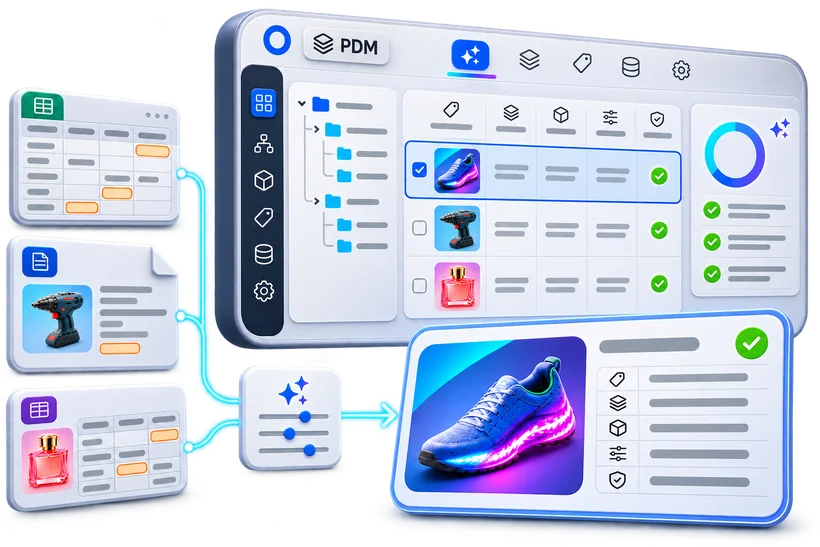
Heterogeneous supplier files consolidated and standardised in the PDM into a structured product record

A structured, consistent repository, ready to use

Product data rarely comes from a single, well-structured source. ERPs, manufacturers, suppliers and business systems send information that differs in format, nomenclature, attributes and quality.

Pimalion’s PDM builds, organises and optimises your product repository. It consolidates information, harmonises structures, standardises attributes and their values, flags inconsistencies and measures content quality.

With the ETL and Purify AI, it prepares reliable, consistent and complete data, ready to feed the PIM, the DAM and your commercial channels.

Benefits

  • Consolidation of heterogeneous sources
  • AI-assisted nomenclatures and models
  • Standardised attributes, values and units
  • Bulk processing and deduplication
  • Quality rules and scores per use
  • Fab-Dis, ETIM, BMEcat and GS1 standards

The PDM in detail

Nine capabilities to build and control your repository

From consolidating sources to AI assistance, the PDM works on the structure, consistency and quality of data, upstream of every use.

A consistent repository, built from multiple sources

Before a product record is usable, you often have to bring several sources together, match references and decide which information will form the product base. The PDM analyses, consolidates and matches this data to build a structured repository.

It supports building catalogues, migrating repositories, grouping supplier data or rationalising existing systems.

Capabilities

  • Consolidation of multiple sources
  • Repository structuring
  • Reference matching
  • Inconsistencies flagged
  • Heterogeneous data handled
  • Organisation by your business models
  • Bulk processing
  • PIM and DAM fed

Main benefit

A consistent repository built faster, without relying solely on manual work.

Example

A distributor receives several supplier catalogues with different references, descriptions and classifications. The PDM prepares a common repository by harmonising this information and matching products to the distributor’s nomenclature.

The Pimalion difference

Data prepared upstream for more reliable publications

A well-structured repository is not an end in itself: its value shows when it feeds your commercial uses. At Pimalion, data consolidated and standardised by the PDM feeds the PIM and the DAM, then Multichannel Publishing.

  1. 01

    Collect

    ERPs and suppliers, with the ETL

  2. 02

    Consolidate

    Match the sources

  3. 03

    Structure

    Nomenclatures and models

  4. 04

    Standardise

    Values and characteristics

  5. 05

    Check

    Anomalies and quality

  6. 06

    Enrich

    With the PDM and Purify

  7. 07

    Centralise

    In the PIM and DAM

  8. 08

    Use

    E-commerce and publications

Lasting governance

Common models, quality rules and shared indicators: quality becomes a continuous process, not a one-off clean-up. Rights, responsibilities and workflows rely on the platform’s governance tools.

  • Rules set by the organisation
  • Quality dashboards
  • Data, purchasing, marketing and IT

Quality upstream, media downstream

Accurate data from the repository onwards limits late corrections and makes it easier to automate catalogues, folders, POS and digital publications.

  • PIM and DAM fed
  • Fewer late corrections
  • Automated media

A product data specialist

Pimalion’s PDM focuses on building, optimising and ensuring the quality of product data. It is not a general-purpose MDM covering customers, finance or human resources.

  • Product data
  • Large repositories
  • Complex assortments

The quality and structure of data upstream directly determine how effective publications are downstream.

Benefits by role

A repository that serves every team

Data, IT, purchasing, e-commerce, marketing, networks: everyone benefits from working on structured, consistent data.

Data Managers and PIM leads

Building repositories, harmonising attributes, managing nomenclatures and quality checks.

Benefit
A consistent repository, despite the variety of sources.

IT departments

Data organised across systems, repositories and business processes.

Benefit
Fewer inconsistencies, easier information governance.

Purchasing and sourcing

Supplier data integrated and prepared according to common rules.

Benefit
Fewer manual adjustments to supplier catalogues.

E-commerce

Attributes, facets and classifications structured for product presentation and search.

Benefit
More complete, more relevant product pages and filters.

Marketing

Content prepared to feed campaigns and publications.

Benefit
Fewer corrections due to missing data.

Buying groups and networks

Information from many suppliers matched to a common repository.

Benefit
Structuring work shared across entities.

FAQ

Frequently asked questions about the PDM

Another question? Ask it during a demo on your own data.

Book a demo
What is the difference between a PDM and a PIM?

The PDM builds, consolidates, standardises and checks repository data. The PIM organises and uses product information in its business and commercial contexts. The two are complementary.

What is the difference between the ETL and the PDM?

The ETL organises the acquisition, mapping and transformation of data flows. The PDM works on their structure, consistency, classification and business quality.

Can the PDM create a product nomenclature?

Yes. It provides tools to build and optimise nomenclatures and classifications, with AI assistance.

Can attributes from different suppliers be harmonised?

Yes. Standardisation rules bring attributes and values from heterogeneous structures back to a common model.

Can units of measure be converted?

Yes, according to the conversion rules and formats configured.

How does the PDM detect poor-quality data?

Control rules and completeness scores flag information that is missing, inconsistent or does not meet the defined requirements.

Does the PDM identify duplicates?

Yes. It detects and matches potential duplicates. Merge and handling arrangements are defined according to the processes chosen.

Does the PDM support Fab-Dis, ETIM, BMEcat and GS1?

Pimalion integrates and processes data from these standards, according to the project’s flows and configuration.

Does the PDM use artificial intelligence?

Yes. The PDM and Purify provide assistance with classification, attribute extraction, structuring and data enrichment.

Can it handle several million references?

Yes. Pimalion projects include very large repositories, particularly in professional distribution.

Can the PDM feed the PIM directly?

Yes. Structured, standardised data feeds Pimalion’s PIM and DAM.

Can Purify be used without Pimalion’s PIM?

Yes. Purify is also available as a standalone service connected to a third-party system.

Is the PDM a general-purpose MDM?

No. Pimalion’s PDM specialises in building, optimising and ensuring the quality of product data. It does not cover the company’s other master data, such as customers, finance or human resources.

Take the next step

See Pimalion with your own data.

A tailored demo: your catalogue, your flyers, your channels. 45 to 60 minutes.

  • With your data

    Your catalogue, your media

  • 45 to 60 minutes

    Prepared for your business

  • A clear quote

    Only the offers you need